
For contractors
Your work deserves a better first impression.
A website that shows the quality of what you build, says where you work, and makes the next conversation easy to start. Written in plain language, built to read well on a phone in a truck.

The work
What you get.
Agreed in writing before anything starts, delivered as written.
A clear picture of your business
Service pages and a service area written around the work you actually take on, not a generic list of trades.
A place to show your projects
Photographs and short project notes that help a homeowner judge whether you are the right fit before they call.
One easy way to get in touch
A short estimate request that asks for the type of work, the town and a sentence about the job. Tested on a phone before launch.
A documented handover
Domain, hosting, ownership and any ongoing support agreed in writing before the build starts, and handed over at the end.
A shared effort
Your part in it.
You supply or approve the business details, the service area, the project photos you are allowed to publish and your contact details. Before anything starts we agree who writes the copy, how many review rounds there are and what happens after launch.
Common questions
Asked before, answered here.
How long does a website take?
We set the schedule after agreeing the page count and the content. The build itself is measured in weeks, not months; the usual delay is photos and approvals, so we plan for those up front.
Can you replace my existing website?
Yes. We first look at the current pages, the domain, the hosting and anything that has to keep working, such as a booking tool. Migration is included only when it is written into the scope.
Does a website guarantee more leads?
No. It gives people a clearer way to understand and contact you. Demand in your area, your reviews and how fast you answer the phone matter as much as the site.
Who owns the site?
You do, once the project is paid for. Ownership, access and what we keep (nothing, unless you ask for care) are written into the scope.
Up to five pages, one design direction, two consolidated revision rounds, a tested contact form and a documented handover. Domain, hosting and ongoing care are separate.
Project and pilot fees are fixed, not hourly. Third-party costs are itemised separately and never marked up quietly.
See the approach
A working example.
Alder & Stone: a fictional business, a real set of pages, and the decisions behind them explained.
Open the project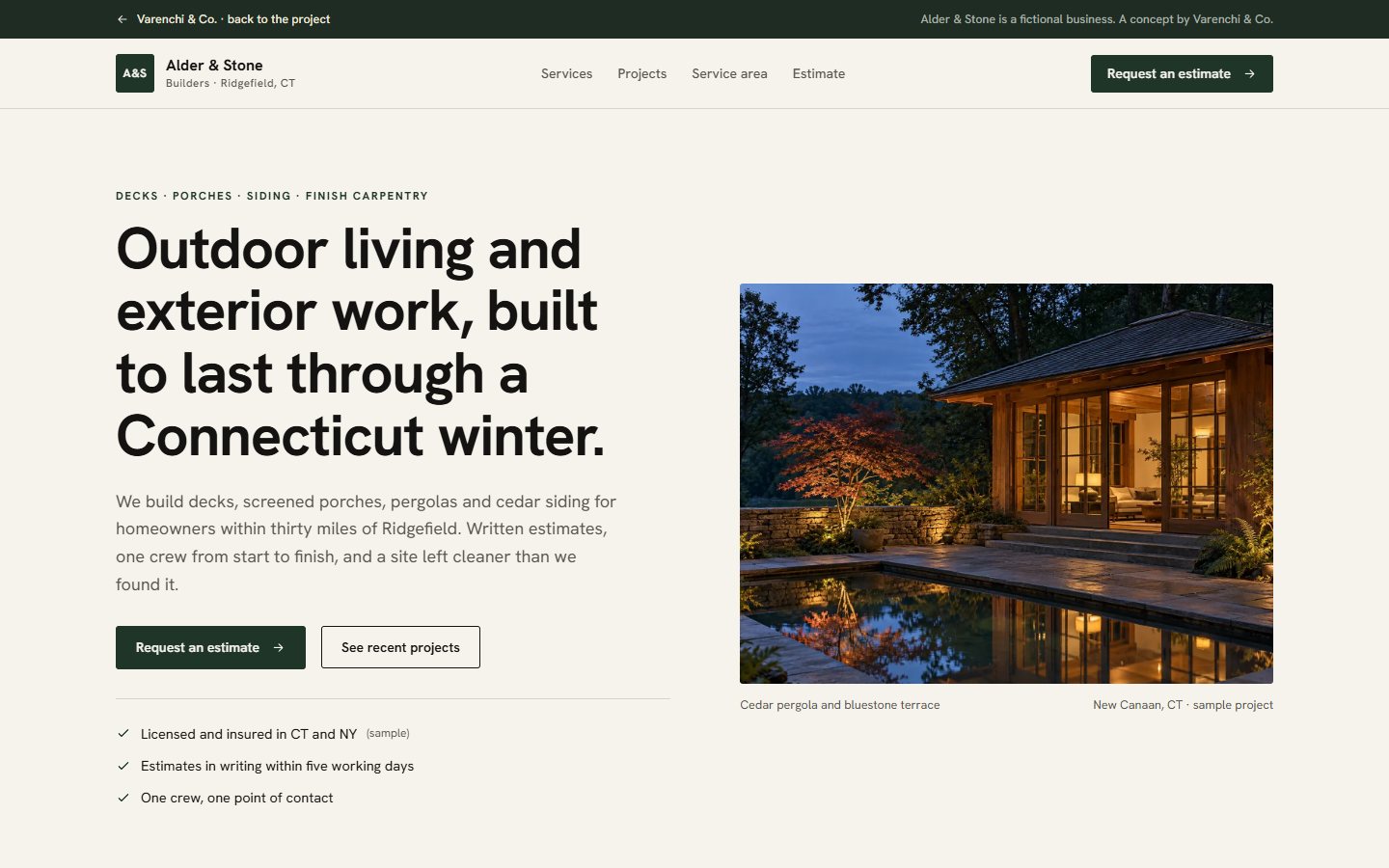
Next step
Tell us about the situation.
Two or three sentences is enough. You get questions back, or a written scope.